
Pricing What Legacy Ignores
By Betsy Moszeter | Harbor Ridge Investments and Danielle M. Burns | Adasina Social Capital
The Modern Institutional Dilemma

For decades, institutional asset management has operated on a foundational assumption: that financial resilience can be predicted almost entirely through historical balance sheet data, share-price volatility relative to the market, and other backward-looking financial metrics. When ESG criteria entered the mainstream as an alternative, many hoped it would broaden this perspective. Instead, first-generation ESG (often termed "ESG 1.0") largely replicated the same static approach—relying on third-party checklists, box-checking scores, and off-the-shelf funds that overlook both how a company earns its revenue and its underlying operational realities.
Today, investors face an economic landscape shaped by rapid environmental transitions, supply chain vulnerabilities, labor shifts, and systemic inequality. Managing risk in this environment requires a fundamentally modernized architecture for value creation—one that expands what we measure, accounts for unpriced externalities, and challenges long-held industry assumptions about resilience.
What Investors Are Asking For Today
Across institutional portfolios, foundation boards, endowments, and family offices, the nature of the conversation is changing. Institutional allocators are moving past simplistic negative screening and generic sustainability labels. They are increasingly recognizing that the traditional tools used to assess risk were designed for an economic era that no longer exists.
When investors evaluate portfolios today, they are asking deeper questions:
How vulnerable is the supply chain to localized environmental stress?
How are labor dynamics and workplace culture impacting long-term operational retention?
Are existing portfolio allocations aligned with the systemic transitions occurring across our economy?
The result is a pivotal shift from asking, "What should we exclude?" to a far more consequential question: "What are we not yet seeing?"
This is where movement-informed data—insights grounded in labor dynamics, racial and gender equity, climate transition, and community accountability—can serve as an important source of leading risk intelligence. When an investment process incorporates data sourced from the frontlines of these issues, it can surface operational vulnerabilities, regulatory exposure, and reputational risk before they are reflected in conventional financial metrics.
For forward-thinking investors, the question is no longer whether these considerations belong in an investment process, but whether a rigorous fiduciary process can afford to ignore material information simply because it falls outside legacy datasets. Integrating these insights is not a values-driven concession; it is an essential dimension of modern fiduciary analysis.
Rebuilding the Mechanics of Asset Allocation
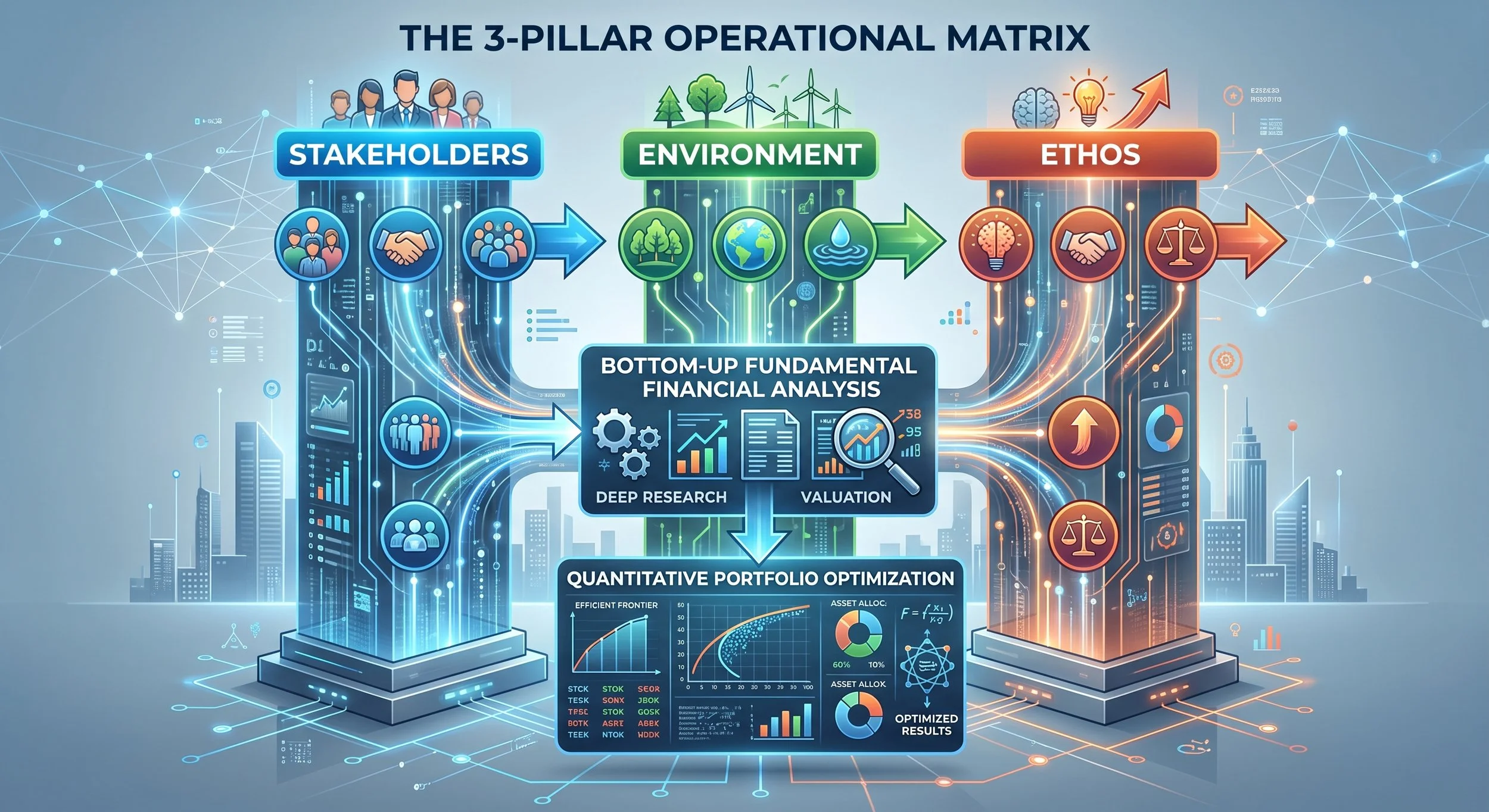
Recognizing that legacy datasets fall short is only half the equation; the real challenge lies in implementation. How do we operationalize broader qualitative insights—like human capital health, supply chain integrity, active stakeholder responsiveness, and corporate governance—without compromising portfolio integrity, liquidity, or fiduciary rigor?
The solution requires moving past narrow screening approaches and implementing a multi-pillar investment engine that bridges qualitative depth with quantitative discipline.
In practice, this begins by expanding the analytical universe beyond balance sheet data to evaluate both how a company generates its revenue and how it manages core operational pillars: Stakeholders, Environment, and Ethos. Auditing qualitative and quantitative indicators across areas like human equity, workforce stability, climate risk and carbon efficiency, industrial water usage, and supply chain integrity can provide insight into how effectively a firm manages off-balance-sheet operational health. These are not simply soft metrics or ideological preferences; they can provide important leading information about operational resilience, material risk, and downside exposure.
From there, these qualitative insights must be subjected to bottom-up fundamental financial analysis. A company may demonstrate exceptional stakeholder practices, but if its balance sheet is overleveraged, its capital allocation is undisciplined, or its valuation is disconnected from economic reality, it may not meet the requirements of an institutional investment mandate. Evaluating balance-sheet durability alongside stakeholder dynamics ensures that holdings are structurally sound.
Finally, portfolio construction should translate these insights into a disciplined quantitative framework rather than relying solely on rigid, one-size-fits-all approaches. Depending on the mandate, institutional allocators can use ETFs, separately managed accounts (SMAs), direct indexing, or custom tailored strategies to balance risk factor exposure, control sector concentration, and maintain liquidity while aligning implementation with an institution's specific requirements.
Integrating deep stakeholder analytics directly into fundamental financial analysis and portfolio construction removes the artificial tradeoff between rigorous risk management and values-aligned capital allocation.
Innovation at the Margins — The Role of Independent Leadership
Independent firms can be particularly well positioned to respond to emerging investor needs. Larger institutions have significant advantages of scale, but their size and complexity may also make experimentation and organizational change more difficult. Independent firms, by contrast, can listen, test, and adapt with speed.
While our own firms operate at the forefront as women-led independent institutions, the broader structural advantage belongs to any team powered by diverse leadership and independent, broad-based ownership. These organizations possess the agility and conviction required to challenge legacy orthodoxies, bypass institutional inertia, and build what modern investors actually need. Untethered from standardized product suites and rigid benchmark-hugging constraints, we believe that independent firms remain closer to the frontline questions investors are actually asking. That proximity allows agile teams to listen, test multi-pillar methodologies, and adapt quickly without navigating layers of organizational bureaucracy—creating space for responsive solutions that might otherwise take years to reach the market.
This structural independence also changes who is at the table. In asset management, leadership diversity is often discussed strictly through a compliance or DEI lens. In practice, however, diverse leadership can be a catalyst for analytical innovation. When leadership teams bring distinct lived experiences and non-traditional perspectives, they can expand the networks through which qualitative data is gathered, ask different questions during corporate engagement, and identify operational blind spots that more homogeneous investment committees may overlook.
Ultimately, independent leadership is less about being different for its own sake and more about creating the structural conditions for responsiveness. In a market where institutional allocators are actively re-evaluating risk, resilience, and alignment, the ability to listen closely and adapt thoughtfully can become a meaningful competitive advantage.
The Roadmap for the Modern Investor
The central challenge facing modern investors is that many analytical tools have failed to keep pace with systemic change. Too much of institutional portfolio management still relies on legacy benchmarks that can overlook modern externalities and potentially unpriced risk. Updating this paradigm does not mean discarding financial discipline; it means building an analytical architecture equipped for current economic realities.
Whether overseeing an institutional endowment, stewarding client wealth, or directing personal retirement savings in an IRA or 401(k), investors across every tier can demand more from asset managers:
Demand holistic operational and business-model integrity. Move beyond static ESG scores to evaluate what a company sells to generate revenue alongside qualitative, movement-informed data and primary-source stakeholder metrics.
Insist on true financial integration over superficial overlays. Treat off-balance-sheet externalities and stakeholder dynamics as potentially material operational risks, pairing them directly with fundamental financial analysis and quantitative portfolio construction.
Seek flexible, precision execution. Use implementation structures appropriate to the mandate—whether ETFs, separately managed accounts (SMAs), direct indexing, or custom tailored strategies—to manage risk exposures while maintaining alignment with portfolio objectives.
By pairing movement-informed data with disciplined portfolio construction, investors of every size can build portfolios that are not only resilient against emerging risks, but better equipped to identify and respond to the forces shaping long-term value creation.
###
Harbor Ridge Investments (“Harbor Ridge”) is a specialty division of Reflection Asset Management (“RAM”), which is an investment adviser registered with the Securities and Exchange Commission (“SEC”) under the Investment Advisers Act of 1940. Robasciotti and Associates, Inc. dba Adasina Social Capital (“Adasina”) is a Registered Investment Advisor. SEC registration does not constitute an endorsement of the firm by the Commission, nor does it indicate that the adviser or investment adviser representative has attained a particular level of skill or ability.
Transmission of the information contained herein is not intended to create, and receipt does not constitute a client relationship. This material is provided for informational purposes only and is not intended to be, and should not be construed as, an offer, solicitation or recommendation with respect to any transaction and should not be treated as legal advice, investment advice or tax advice. Recipients should not rely upon this information as a substitute for obtaining specific legal or tax advice from their own professional legal, investment, or tax advisors. The investor must ensure the suitability of an investment as it pertains to their financial and fiscal situation and investment objectives. Before acting on any information in this material, it is prudent to consult one’s financial advisor.
For additional disclosures and disclaimers, visit http://adasina.com/regulatory-information and https://www.harborridgeinv.com/disclosures