
Beyond the Black Box: Why ‘Proof over Labels’ is the New Standard for the $124 Trillion Wealth Transfer
Doug Heske of Causeway Impact and I recently sat down with Joan Michelson to discuss what she aptly calls the "seismic power shift" currently reshaping global finance. This isn't just a trend; it’s a dual-engine mobilization of capital, fueled by the intersection of a historic generational hand-off and the explosive rise of women’s economic agency.
Boomers benefited from a unique period of market growth, real estate appreciation, and corporation expansion. Now, we are witnessing the unwinding of the greatest wealth accumulation period in recorded human history. The money is moving because it has to—the owners are aging out of the workforce and the market.
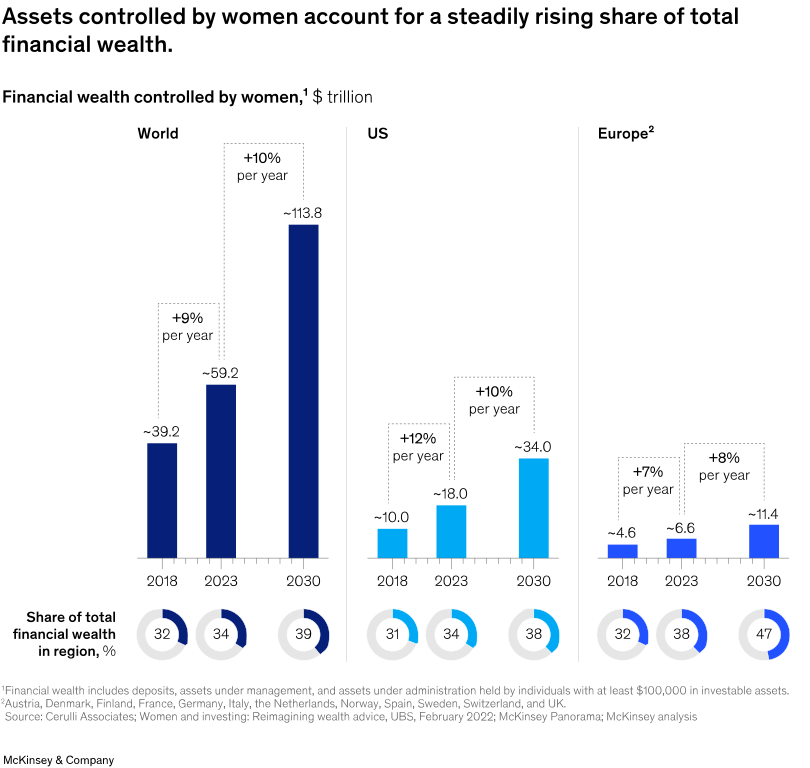
While data suggests $124 trillion (or other similarly large numbers) is in motion through 2048, this Great Wealth Transfer is only half the story. The more immediate shift is the $34 trillion McKinsey projects women will control by 2030.
We are moving past the era of passive inheritance. Today, women are the architects of their own wealth, powered by what I call the Education Edge, as they now earn 59% of all undergraduate degrees and 63% of all master’s degrees in the U.S. This academic dominance is fueling a greater presence in the executive suite and a rise in board seats, allowing women to create and command capital at an unprecedented rate.
This isn't just a change in ownership; it’s a shift in the world’s financial DNA. With 82% of heirs demanding rigorous verification, and women being twice as likely as men to prioritize values-alignment in their portfolios, we believe that the 'marketing label' version of ESG is officially obsolete. When you combine the next generation’s skepticism with the fact that 74% of women now identify as impact-focused investors, we’ve moved from the age of trust to the age of proof. The $124 trillion question is why the industry is struggling to provide it. The answer lies in a marketing veneer that is finally beginning to crack under the weight of sophisticated scrutiny.
The primary culprit? The ESG label itself.
As we discussed in the interview, the first era of impact investing was defined by marketing. The next era will be defined by mathematical proof.
The Failure of the "Black Box" Score
The failure of the "black box" isn't just a minor technical glitch; it is a structural collapse caused by two distinct problems.
The Consistency Gap: The Lack of a "North Star"
First, there is no industry standard for what a "good" score even looks like. While credit ratings from agencies like S&P and Moody’s have a near-perfect correlation of 0.99, research into 'Aggregate Confusion' shows that ESG ratings from major providers correlate at an average of only 0.54.
This means that if you look across the major ratings providers, a company’s “A” is frequently another provider’s "C." This isn't just a difference in opinion; it’s a measurement divergence that leaves investors with no objective North Star to guide their capital.
The Logic Gap: Rewarding Disclosure over Impact
The second, more damning problem is that these scores often measure the wrong things. Traditional ESG models frequently reward "Check-the-Box" corporate disclosures—the sheer volume of policy brochures and carbon-reporting paperwork a company produces—rather than actual real-world outcomes.

To see this absurdity in practice, look at the widely reported inclusion of Philip Morris International in the Dow Jones Sustainability World Index. Under legacy scoring methodologies, a tobacco giant can secure "Prime" status by investing heavily in disclosure and "risk management" narratives.
How? Because the system weights a company’s ability to manage its financial risk from ESG factors more heavily than the actual impact of its product on human health. In a world governed by these black boxes, a fund manager could sell a pure-play, mission-driven renewable energy firm and buy a global tobacco leader, and their portfolio’s ESG score would technically improve. This isn't just a flaw in the system; it is a total disconnect from the Ethos that modern investors are increasingly looking for.
At Harbor Ridge Investments, we’ve moved beyond the opinion phase. By leveraging CIO Jason Britton’s patented Reflection Analytics, we utilize a recommendation engine that conducts real-time automated analysis across 200+ data points.
Instead of waiting for an annual report, our technology provides an objective, institutional-grade view of a company’s alignment. This is the difference between trusting a label and verifying the data.
The S.E.E. Framework: Re-Engineering Alpha
Since achieving the status quo isn’t the goal, we don't just look at sustainability; we look at Stakeholders, Environment, and Ethos (SEE). This framework is designed to capture the hidden drivers of corporate performance that traditional financial analysis ignores.
Stakeholders (The Human Equity Pillar):We treat Human Capital as a primary performance indicator, not a "social" afterthought. While the S in ESG has historically been the hardest to measure, we use our patents to transform ‘soft’ metrics into hard financial data. Grounded in research from the Yale School of Management and the World Economic Forum, our analytics measure things like pay equity, employee retention, and boardroom diversity as predictors of operational resilience.
This focus is backed by WEF data showing that companies prioritizing their people in this way consistently outperform their peers during periods of market volatility. We are looking for regenerative workforces—companies that mitigate the expensive risks of high turnover and cultural decay. In a volatile market, Human Equity can be the ultimate hedge.
Environment (The Net Positive Pillar): We move beyond the distraction of carbon offsets to analyze the Net Positive impact of a company’s entire value chain. We prioritize the footprint of its products and services over mere operational adjustments. Grounded in the frameworks of Paul Polman and the Stockholm Resilience Centre, we evaluate whether a company’s core offerings—what it actually sells to the world—are actively decoupling growth from resource depletion.
Ethos (The Integrity Pillar): This is the most critical and often overlooked metric—the "DNA" of the organization. Drawing on research from Harvard Business Review and MIT Sloan regarding high-trust organizations, we quantify leadership integrity and corporate culture as the ultimate risk hedge. If a company’s Ethos is misaligned, the Environmental and Stakeholder pillars will eventually crumble; if it is strong, it acts as a multiplier for every other asset.
Democratizing the "Next Phase" with Causeway
Innovation is meaningless if it’s locked away for only the ultra-wealthy. This is why our partnership with the Causeway Impact is so vital.
Causeway represents the first unified values ecosystem, allowing investors to align their philanthropic giving and their investment portfolios. By integrating Harbor Ridge’s institutional-grade analysis into the Causeway platform, we are giving every investor the tools to track their real-world impact with the same precision that other firms use for their largest clients.
The Verdict: Verification is the New Loyalty
The Next Gen investor doesn't give their loyalty to a brand; they give it to a process that is quantifiable, proven, and repeatable.
As trillions of dollars move into the hands of those who demand accountability, the firms that win will be those that provide Proof over Labels. We are proud to be at the forefront of this shift, using patented processes and academic rigor to turn "impact" from a buzzword into a verifiable financial reality.
###
Harbor Ridge Investments (“Harbor Ridge”) is a specialty division of Reflection Asset Management (“RAM”), which is an investment adviser registered with the Securities and Exchange Commission (“SEC”) under the Investment Advisers Act of 1940. SEC registration does not constitute an endorsement of the firm by the Commission, nor does it indicate that the adviser or investment adviser representative has attained a particular level of skill or ability.
Past performance is not indicative of future results. The material above has been provided for informational purposes only and is not intended as legal or investment advice or a recommendation of any particular security or strategy. The investment strategy and themes discussed herein may be unsuitable for investors depending on their specific investment objectives and financial situation. Information obtained from third-party sources is believed to be reliable though its accuracy is not guaranteed, and Harbor Ridge makes no representation or warranty as to the accuracy or completeness of the information, which should not be used as the basis of any investment decision. Information contained on third party websites that Harbor Ridge may link to is not reviewed in their entirety for accuracy and Harbor Ridge assumes no liability for the information contained on these websites. Opinions expressed in this commentary reflect subjective judgments of the author based on conditions at the time of writing and are subject to change without notice. No part of this material may be reproduced in any form, or referred to in any other publication, without express written permission from Harbor Ridge Investments. For more information about Harbor Ridge Investments, including our Form ADV brochures, please visit https://adviserinfo.sec.gov or contact us at bmoszeter@harborridgeinv.com.