
The $44 trillion question: why your portfolio needs biodiversity

Nature and Biodiversity: Aligning Economies with Nature from the World Economic Forum
By Jason Britton
Originally published in the GreenMoney Journal
This October issue of GreenMoney feels particularly timely as we confront the economic and societal significance of biodiversity against the current political climate of the United States. As Chief Investment Officer, I’ve seen firsthand how the conversation around sustainable investing has evolved. Once primarily focused on climate change and carbon emissions, the spotlight is now rightfully expanding to encompass the intricate web of life that sustains our planet – biodiversity.
For too long, the financial markets viewed nature as an endless resource, an externality to be exploited rather than an essential asset to be protected and nurtured. This mindset has led us to a critical juncture. The World Economic Forum consistently ranks biodiversity loss as one of the top global threats, recognizing that over half of the world’s GDP – a staggering $44 trillion – is moderately or highly dependent on nature and its services. The implications of this are profound, impacting everything from food security and water availability to the stability of ecosystems and the resilience of supply chains.
We understand that investing in nature is not merely an ethical imperative; it is a strategic imperative. It’s about building long-term resilience, mitigating systemic risks, and tapping into the significant opportunities presented by the transition to a nature-positive economy. Our approach to global equity markets is deeply informed by this conviction, moving beyond traditional ESG screening to actively identify and support companies that are not just minimizing harm, but are positively contributing to the preservation and restoration of biodiversity.
The interconnectedness of crises: climate and biodiversity
It’s impossible to discuss biodiversity without acknowledging its intrinsic link to climate change. These are not isolated crises but rather two sides of the same coin. Climate change accelerates biodiversity loss through habitat destruction, altered ecosystems, and increased frequency of extreme weather events. Conversely, healthy biodiverse ecosystems act as powerful natural climate solutions, absorbing carbon, regulating water cycles, and providing natural defenses against climate impacts. Investing in one without addressing the other is akin to treating a symptom while ignoring the underlying disease.
This awareness is at the core of our investment philosophy. Our research process delves deep to identify those companies that are demonstrating leadership in climate change and biodiversity, integrating nature-based solutions into their core business models, and innovating for a regenerative future.
Our approach: from exclusion to impact
Traditional ESG investing often begins with exclusionary screens – avoiding companies involved in industries deemed harmful, such as fossil fuels or controversial weapons. While this is a necessary first step, it’s insufficient for truly addressing complex challenges like biodiversity loss. We go further, focusing on a “solutions-oriented” approach. We ask: who are the companies that are actively developing and deploying solutions for a nature-positive world?
Our investment process is rooted in a multi-factorial quant-focused analysis, combining rigorous screening with deep fundamental research. This allows us to identify companies that are:
Innovating for Biodiversity: We seek out companies that are developing technologies, products, and services that directly address the drivers of biodiversity loss. This includes, but is not limited to, sustainable agriculture and forestry, precision farming, biotechnologies for ecological restoration, waste reduction and circular economy solutions, and advancements in sustainable materials. For example, we might invest in companies pioneering vertical farming to reduce land use, or those developing biodegradable alternatives to plastics.
Stewarding Natural Capital: We look for companies that demonstrate exemplary stewardship of natural resources within their own operations and supply chains. This involves assessing their water usage, land management practices, pollution prevention measures, and commitment to responsible sourcing. We seek to uncover management teams that have biodiversity action plans, publish their progress on targets, and provide transparency in reporting. Companies that have robust nature-related risk assessments and actively work to reduce their ecological footprint are of particular interest.
Contributing to Ecosystem Restoration: Beyond minimizing negative impacts, we actively seek companies that are involved in restoring degraded ecosystems. This could be through large-scale reforestation projects, wetland restoration, or supporting sustainable fisheries that rebuild depleted marine populations. We are keen on companies that are investing in natural infrastructure, recognizing its value in providing essential ecosystem services.
Aligned with Global Frameworks: We align our investment themes with internationally recognized frameworks such as the UN Sustainable Development Goals (SDGs), particularly SDG 14 (Life Below Water) and SDG 15 (Life on Land). The Global Biodiversity Framework (GBF), agreed upon at COP15, provides a crucial roadmap, and we monitor how companies are responding to its ambitious targets, especially the “30 by 30” goal – protecting 30% of land and sea areas by 2030. These frameworks provide a common language and a shared aspiration for a nature-positive future.
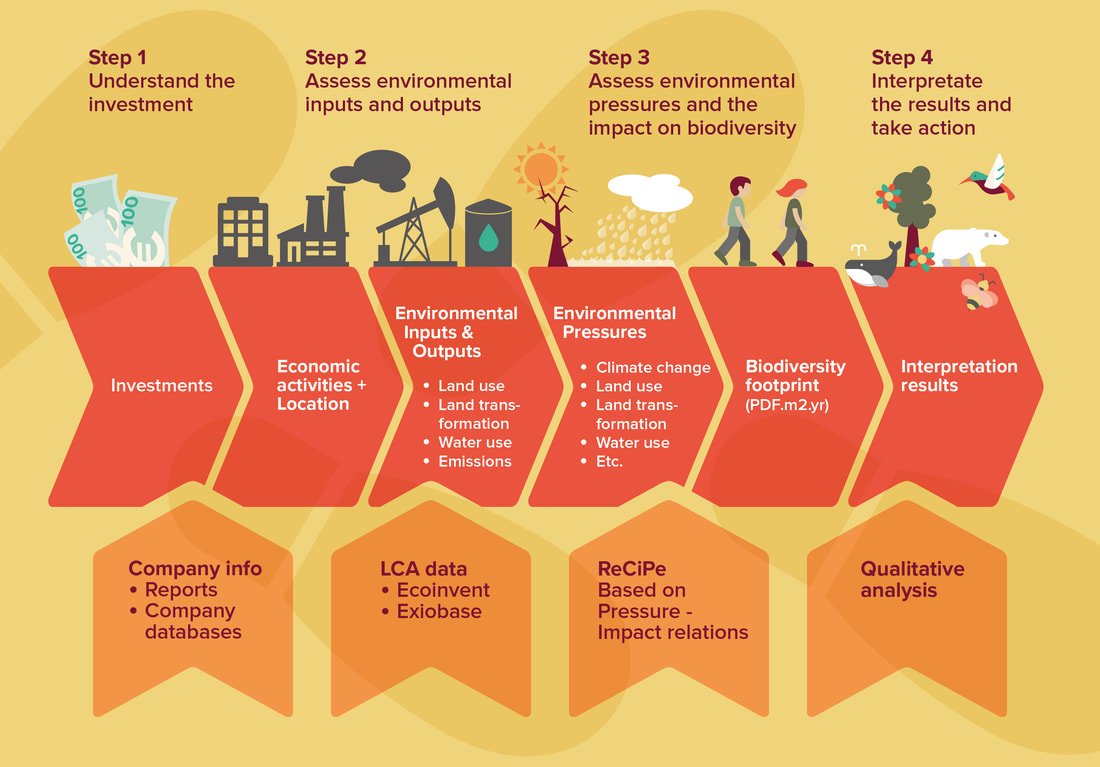
Biodiversity Footprint for Financial Institutions (BFFI) Method
Measuring what matters: beyond financial returns
One of the challenges in biodiversity investing has been the difficulty in quantifying impact. Unlike carbon emissions, which have established metrics, biodiversity is complex and multi-faceted. However, advancements in data and analytics are rapidly improving our ability to measure and track nature-related impacts and dependencies. We leverage proprietary tools and partner with leading data providers to gain a granular understanding of our portfolio companies biodiversity performance. This includes:
Geospatial Data Analysis: Utilizing satellite imagery and geospatial data to assess land use changes, deforestation risk, and proximity to biodiversity hotspots for our portfolio companies’ operations and supply chains.
Biodiversity Foot Printing: Employing methodologies like the Biodiversity Footprint for Financial Institutions (BFFI) to estimate the impact of our investments on biodiversity in terms of hectares restored or protected.
Engagement and Disclosure: Actively engaging with companies to encourage robust disclosure of their nature-related risks, opportunities, and performance, in line with frameworks like the Taskforce on Nature-related Financial Disclosures (TNFD). We believe that transparent reporting is crucial for accountability and for driving positive change.
Beyond these quantitative measures, we recognize the importance of qualitative assessment. This involves understanding a company’s commitment to nature from the top down, their partnerships with conservation organizations, and their broader contribution to building a regenerative economy.
The economic upside of nature positive
It’s vital to underscore that our focus on biodiversity is not at the expense of financial returns. In fact, we believe the opposite is true. Companies that proactively address biodiversity risks and embrace nature-positive solutions are often better positioned for long-term growth and resilience.
Risk Mitigation: Companies with strong biodiversity management practices are less exposed to regulatory risks (e.g., stricter environmental laws), reputational risks (e.g., consumer boycotts), and operational risks (e.g., disruptions due to ecosystem collapse).
Innovation and New Markets: The transition to a nature-positive economy is unlocking new markets and driving innovation. Companies developing sustainable alternatives, nature-based solutions, and circular economy models are poised for significant growth.
Operational Efficiencies: Investing in resource efficiency, waste reduction, and sustainable sourcing can lead to cost savings and improved operational performance.
Enhanced Brand Value: Consumers, increasingly aware of environmental issues, are gravitating towards brands that demonstrate genuine commitment to sustainability, including biodiversity.
Early data is encouraging. Research by organizations like MSCI suggests that portfolios with lower biodiversity risks tend to deliver higher cumulative returns. This reinforces our conviction that doing good and doing well are increasingly intertwined.
A call to action for the investment community
The scale of the biodiversity crisis demands a collective response. As investors, we have a powerful role to play in directing capital towards solutions and holding companies accountable.
We are committed to remaining at the forefront of this shift. We invite our fellow investors to:
Educate Themselves: Deepen their understanding of biodiversity, its economic implications, and the interconnectedness of environmental crises.
Integrate Biodiversity into Investment Decisions: Move beyond climate-centric ESG and explicitly incorporate nature-related risks and opportunities into their investment frameworks.
Demand Transparency and Disclosure: Pressure companies to provide comprehensive and standardized reporting on their biodiversity impacts and dependencies.
Support Nature-Positive Innovation: Actively seek out and invest in companies that are developing and scaling solutions for a regenerative economy.
Collaborate and Engage: Work with other investors, policymakers, and civil society organizations to accelerate the transition to a nature-positive future.
The future of our planet, and indeed, our global economy, hinges on our ability to halt and reverse biodiversity loss. Investing in nature is not a niche strategy, but a core component of responsible and forward-looking portfolio management. As Chief Investment Officer, I am proud that we are leading the charge, demonstrating that financial returns and positive environmental impact can, and must, go hand in hand. The time to invest in nature is now.
###
Harbor Ridge Investments (“Harbor Ridge”) is a specialty division of Reflection Asset Management (“RAM”), which is an investment adviser registered with the Securities and Exchange Commission (“SEC”) under the Investment Advisers Act of 1940. SEC registration does not constitute an endorsement of the firm by the Commission, nor does it indicate that the adviser or investment adviser representative has attained a particular level of skill or ability.
Past performance is not indicative of future results. The material above has been provided for informational purposes only and is not intended as legal or investment advice or a recommendation of any particular security or strategy. The investment strategy and themes discussed herein may be unsuitable for investors depending on their specific investment objectives and financial situation. Information obtained from third-party sources is believed to be reliable though its accuracy is not guaranteed, and Harbor Ridge makes no representation or warranty as to the accuracy or completeness of the information, which should not be used as the basis of any investment decision. Information contained on third party websites that Harbor Ridge may link to is not reviewed in their entirety for accuracy and Harbor Ridge assumes no liability for the information contained on these websites. Opinions expressed in this commentary reflect subjective judgments of the author based on conditions at the time of writing and are subject to change without notice. No part of this material may be reproduced in any form, or referred to in any other publication, without express written permission from Harbor Ridge Investments. For more information about Harbor Ridge Investments, including our Form ADV brochures, please visit https://adviserinfo.sec.gov or contact us at bmoszeter@harborridgeinv.com.